Prince Boudwin
Le Morte d'ArthurPrince Boudwin is King Mark’s brother, a popular Cornish prince remembered for defending his country and for his loyalty to Sir Tristram. His decisive appearance in the story ends in murder: Mark, resentful of Boudwin’s honor and affection for Tristram, kills him after a successful defense against Saracen invaders. The prince’s death drives his wife, Anglides, and their young son, Alisander le Orphelin, into flight.
Identity and place in the story
The narrative presents Boudwin as a good prince whom the people of his country loved greatly. He is King Mark’s brother, Anglides’s husband, and the father of their young son, Alisander le Orphelin. His ties also reach into the circle around Tristram: Boudwin loves him, and Tristram is among those who mourn the prince after his death.
Boudwin’s role is brief but consequential. His public service demonstrates the difference between the honor earned by protecting the country and the insecure authority of a ruler who cannot bear a relative’s popularity. The contrast turns a military success into the cause of a family murder and a forced departure from Cornwall.
Defense of Cornwall
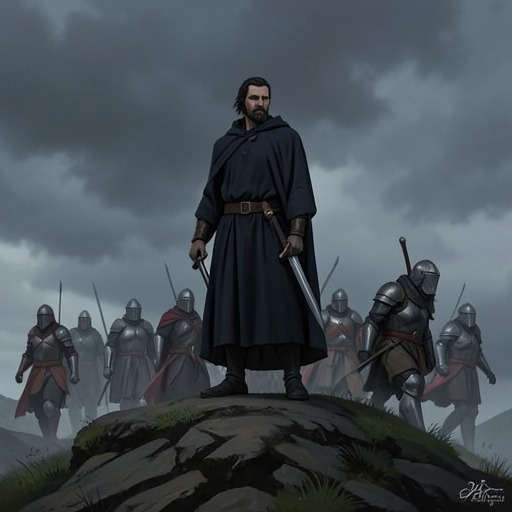
After the Sessoynes have left, Saracen forces land in Cornwall. Boudwin responds quickly and secretly, raising the country before daybreak rather than waiting to seek help from Mark. He sets fire to three of his own ships and has them driven by the wind into the Saracen fleet. The burning ships destroy the enemy vessels; when daylight comes, Boudwin and his company attack the invaders and kill forty thousand, according to the account.
The victory establishes both his competence and the scale of the acclaim that follows. Mark hears of Boudwin’s success and becomes angry that his brother has gained such honor. The text also identifies Boudwin’s popularity—he is better loved in the country than Mark—as a source of the king’s resentment. His service protects Cornwall, but its public recognition sharpens the threat Mark perceives in his own brother.
Murder by King Mark
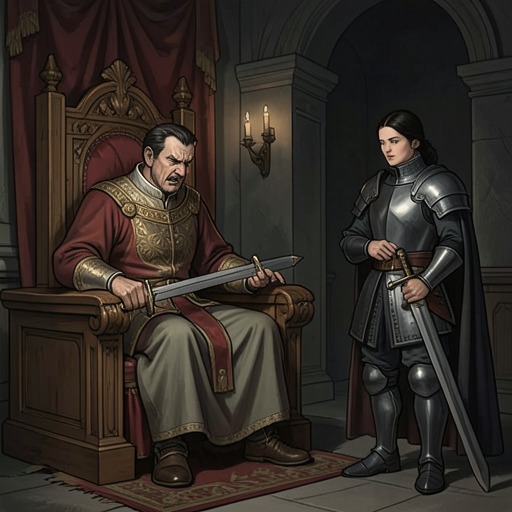
Mark’s hostility is compounded by Boudwin’s affection for Tristram, whom Mark hates. He decides to kill Boudwin and summons him, Anglides, and their young son under the pretext that he wishes to see the child. Mark receives the family with apparent cordiality and waits until after dinner before confronting his brother about the victory.
Mark accuses Boudwin of keeping him uninformed and taking the honor for himself. Boudwin answers that delay would have allowed the invaders to destroy his country. Mark rejects the explanation, accuses him of seeking honor at his expense, and kills him. The killing makes the king’s private rivalry more powerful than kinship or the public good Boudwin has served: the prince’s successful defense of Cornwall becomes the occasion Mark uses to destroy him.
Family and aftermath
Anglides witnesses her husband’s death and collapses in grief. After Boudwin is stripped and taken for burial, she secretly keeps his doublet and shirt. The account records these garments as the personal remains she preserves, while the surrounding events make clear that the family cannot remain safely at court.
Tristram, Sir Dinas, Sir Fergus, and the other knights present mourn Boudwin, whose popularity is again emphasized through the breadth of the grief. La Beale Isoud sends Anglides a warning to leave quickly or her son will also be killed. Anglides escapes on horseback with Alisander and such poor men as dare ride with her. Boudwin’s death therefore does not end with the murder itself: it forces his wife and child from Cornwall and carries the consequences of Mark’s violence into the next generation.
Narrative significance
Boudwin’s episode makes the conflict between public merit and dynastic insecurity concrete. He acts decisively against an invading force, wins a victory for Cornwall, and is loved by its people; those very signs of service and esteem intensify Mark’s fear and resentment. The episode also links two forms of loyalty that Mark treats as threats—Boudwin’s kinship with him and Boudwin’s affection for Tristram—and shows neither bond protecting the prince.
The preserved garments, the mourning of the knights, and Anglides’s hurried escape mark the human consequences of a ruler’s betrayal. Boudwin is absent from the later flight, but his murder is its cause: his family’s survival now depends on leaving the kingdom he had defended.